


Its products are suitable for residential and commercial projects, especially in modern and high-end renovations. Stainless steel cabinets offer strong resistance to moisture, corrosion, and termites, making them ideal for humid environments. KINO serves global clients and provides customized kitchen solutions for designers, developers, and distributors.
There's a moment every homeowner hits when they realize the cabinet they fell in love with online won't fit the awkward corner next to the dishwasher. Or the finish they chose looks completely different under their kitchen's recessed lighting. Or — worst of all — they discover after delivery that the steel gauge is so thin it flexes when you push on the door.
With custom stainless steel kitchen cabinets, these mistakes don't just cost you time. They cost thousands of dollars and weeks of delays. Unlike pulling a stock cabinet off the shelf, ordering custom means making a series of decisions — about material grade, thickness, surface finish, and dimensions — that are essentially locked in once fabrication begins.
This guide exists so you walk into that process with your eyes open. By the time you finish reading, you'll know exactly what questions to ask, what specs to confirm, and where the most common (and expensive) ordering mistakes happen.
Why Choose Custom Over Stock?
Before diving into the technical details, it's worth being honest about when custom actually makes sense — and when it doesn't.
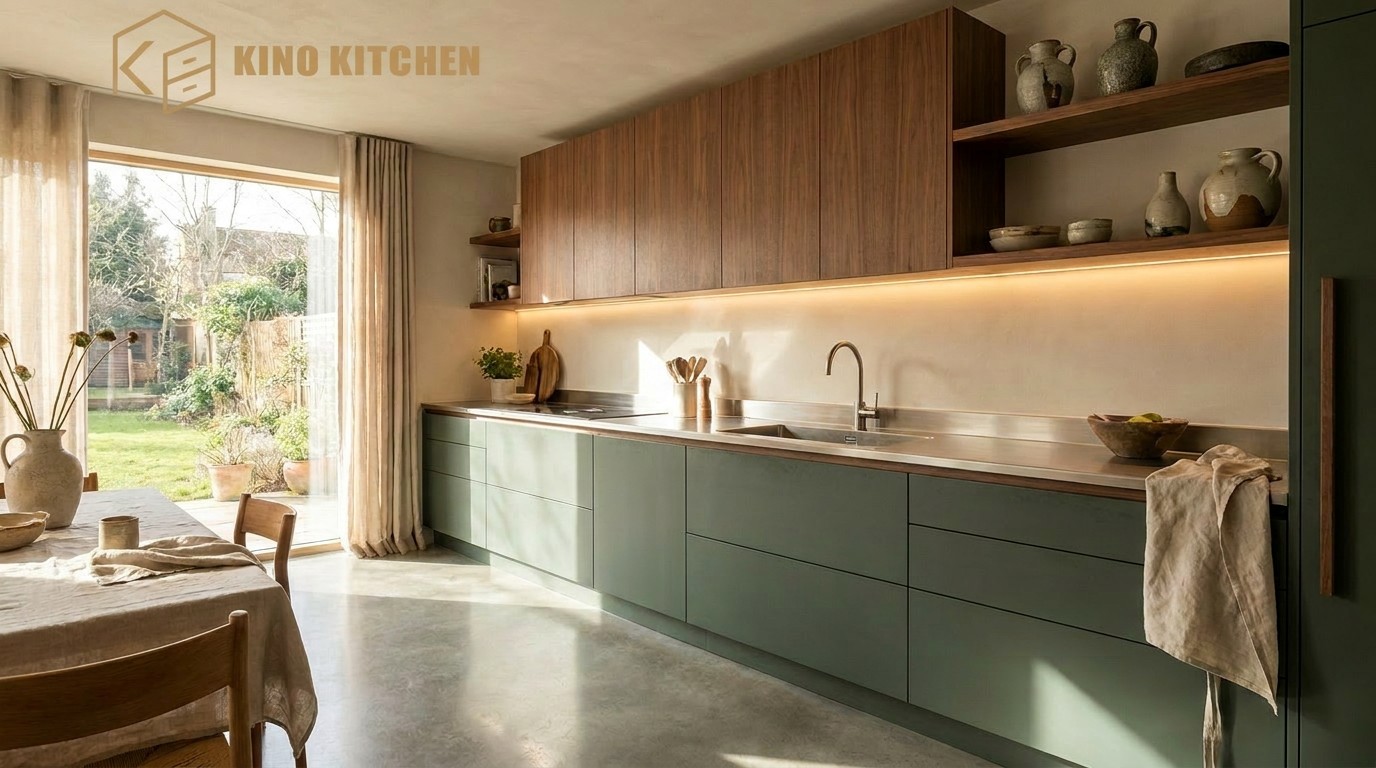
Fully custom cabinets are fabricated to your exact specifications: precise dimensions, non-standard configurations, specific hardware, and any finish or coating you can specify. No size restrictions. No compromises. This is the right path for complex kitchen layouts, architectural builds, and anyone who wants stainless steel in colors or textures that don't exist in standard product lines (such as PVD-coated sage green or champagne gold).
Semi-custom cabinets are factory-produced in fixed size increments — typically 3-inch steps — with selectable options for finish, handles, and internal fittings. They're faster, less expensive, and still flexible enough for most standard kitchen footprints. If your layout is relatively conventional, semi-custom hits a strong price-to-outcome balance.
Modular units are pre-fabricated in fixed configurations and assembled on-site. Lowest cost, zero dimensional flexibility. Suitable only when standard sizes fit your layout without gaps or filler panels.
The decision isn't really about preference — it's about what your kitchen actually requires. A skilled fabricator will tell you honestly which tier is appropriate. One who pushes full custom on a standard layout is selling you margin, not value.
Choosing the Right Steel Grade
Steel grade is the single most consequential decision you'll make. Choose the wrong one and corrosion shows up within months. The right one, and your cabinets outlast every other surface in the kitchen.
The Three Grades You'll Encounter
304 Stainless Steel — the industry standard for residential and commercial interior kitchens. Its composition (18% chromium, 8–10% nickel) creates a self-repairing passive oxide layer that resists rust without coatings or surface treatments. It's food-safe, non-porous, and easy to clean. For most homeowners, 304 is the answer.
316 Stainless Steel — often called "marine grade," 316 adds 2–3% molybdenum to the alloy, which dramatically improves resistance to chlorides, salt, and harsh cleaning chemicals. If your kitchen is within a mile or two of the ocean, if you have an adjacent pool, or if the cabinets will be used outdoors in a humid climate, 316 is worth the 10–30% cost premium. In those environments, 304 will show rust spots within a few years regardless of maintenance.
201 Stainless Steel — a lower-nickel alternative developed to reduce material costs. It functions adequately in dry indoor conditions with minimal exposure to moisture or cleaning chemicals. The problem: many budget fabricators use 201 without disclosing it, and buyers only discover the issue when surface corrosion appears in year two. Always ask for material certification documentation before signing any fabrication agreement.
How to Choose
| Environment | Recommended Grade |
|---|---|
| Standard indoor residential kitchen | 304 |
| Coastal home (within 1–2 miles of ocean) | 316 |
| Indoor kitchen with pool access or heavy chemical cleaning | 316 |
| Outdoor kitchen in non-coastal, low-humidity climate | 304 minimum |
| Outdoor kitchen in coastal or high-humidity environment | 316 required |
| Budget-restricted, covered indoor application | 201 (last resort only) |
Ask your fabricator for their mill certification documents — a legitimate supplier will provide them without hesitation.
Gauge Thickness Matters More Than You Think
"Gauge" refers to the thickness of the steel sheet used to fabricate your cabinets. Here's the counterintuitive part: lower gauge numbers mean thicker steel.
What Each Gauge Actually Delivers
16-gauge (1.52 mm) — the commercial kitchen standard. Used in professional restaurant environments where cabinet doors take constant heavy contact, where impact is frequent, and where structural rigidity is non-negotiable. For a residential home kitchen, this is often over-engineering (and over-budget), unless you're running a serious home cook setup.
18-gauge (1.22 mm) — the high-end residential sweet spot. Strong enough to eliminate the flexing or drumming sound that plagues thinner cabinets, workable enough for fabricators to produce clean, precise welds and edges, and priced sensibly for home applications. If you want the look and feel of a professional kitchen without paying commercial rates, specify 18-gauge.
20-gauge (0.91 mm) — used by some premium residential outdoor cabinet brands for boxes and door panels. Adequate for light-duty home use. Acceptable on cabinet bodies where structural demand is lower, but doors and drawer fronts in this gauge will telegraph dents from normal contact over time.
A simple test before you commit: ask the fabricator what gauge they use for door panels specifically. Budget manufacturers often use 18-gauge for the cabinet body but drop to 20 or 22-gauge for doors — the part of the cabinet you touch and see every day.
Finish Options and What They Actually Mean
The finish you choose determines how the cabinet looks the day it arrives, how it looks five years later, and how much time you'll spend cleaning it. These are meaningfully different decisions.
Brushed (No. 4 / Satin)
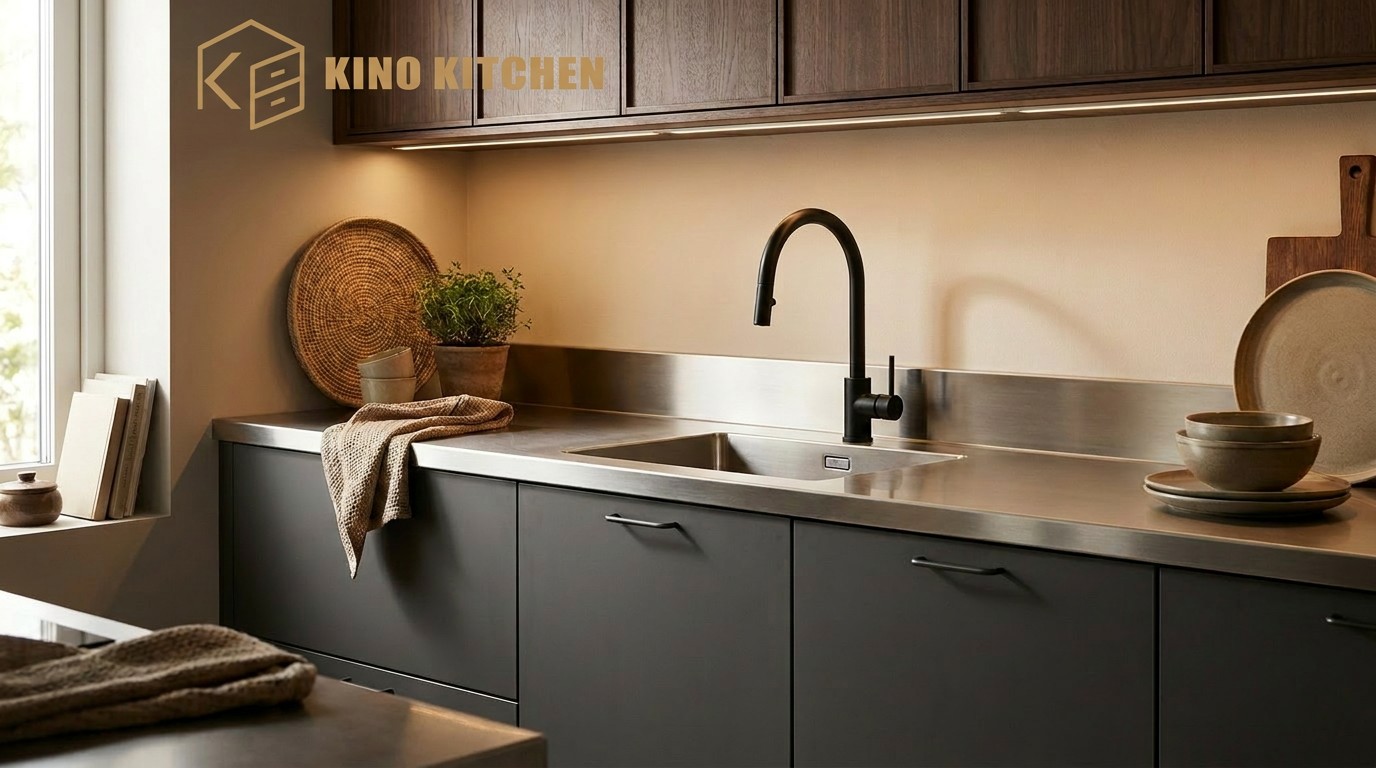
Produced with 120–180 grit abrasive belts, the brushed finish creates a soft, directional texture that scatters light rather than reflecting it. It's the universal standard for kitchens for good reason: it hides fine scratches well, shows fingerprints less than polished alternatives, and maintains its appearance under daily use. If you're uncertain, this is the safe choice.
Mirror-Polished (No. 8)
Striking in photography, demanding in real life. The mirror polish achieves maximum reflectivity through progressive polishing stages, but every smudge, water drop, and fingerprint is immediately visible. In a busy kitchen, expect to wipe these surfaces daily. Best reserved for accent panels or low-traffic display areas rather than full cabinet runs.
Powder-Coated
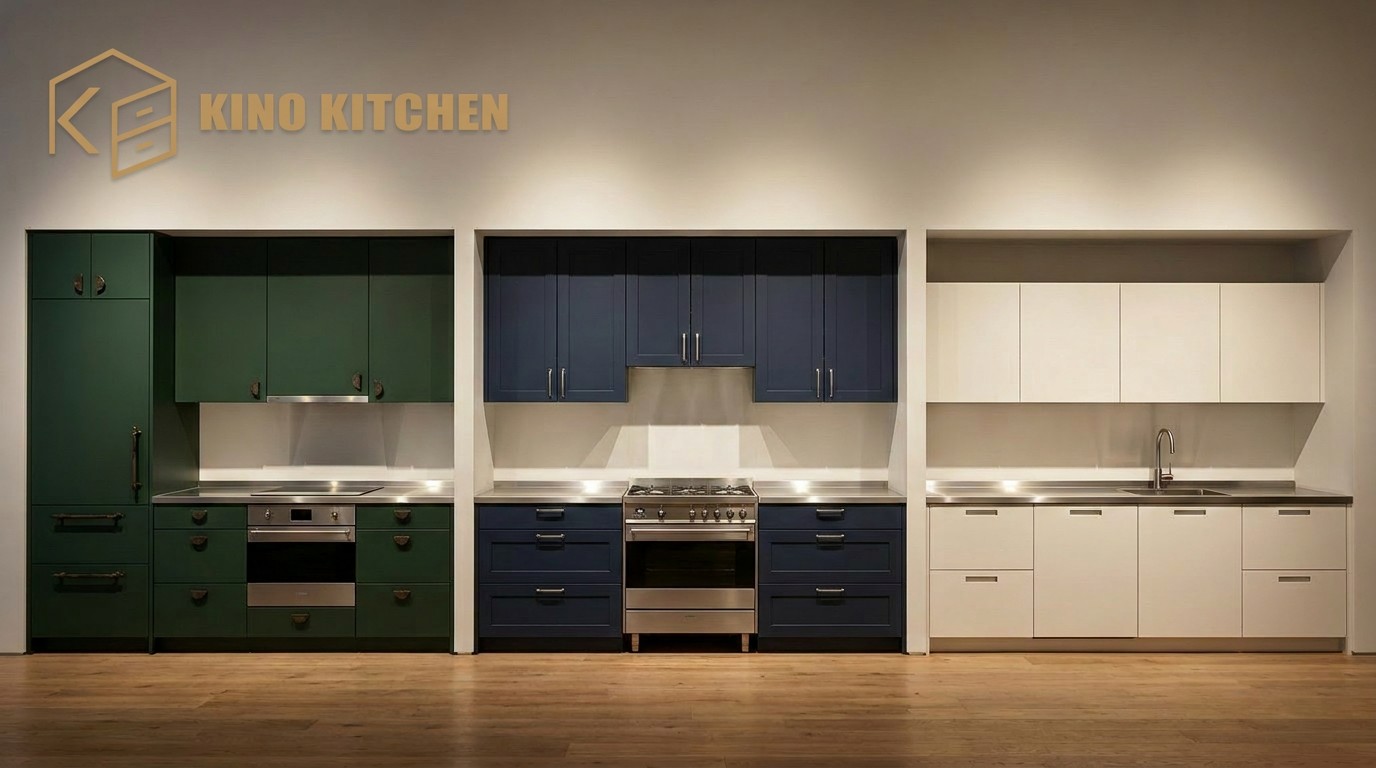
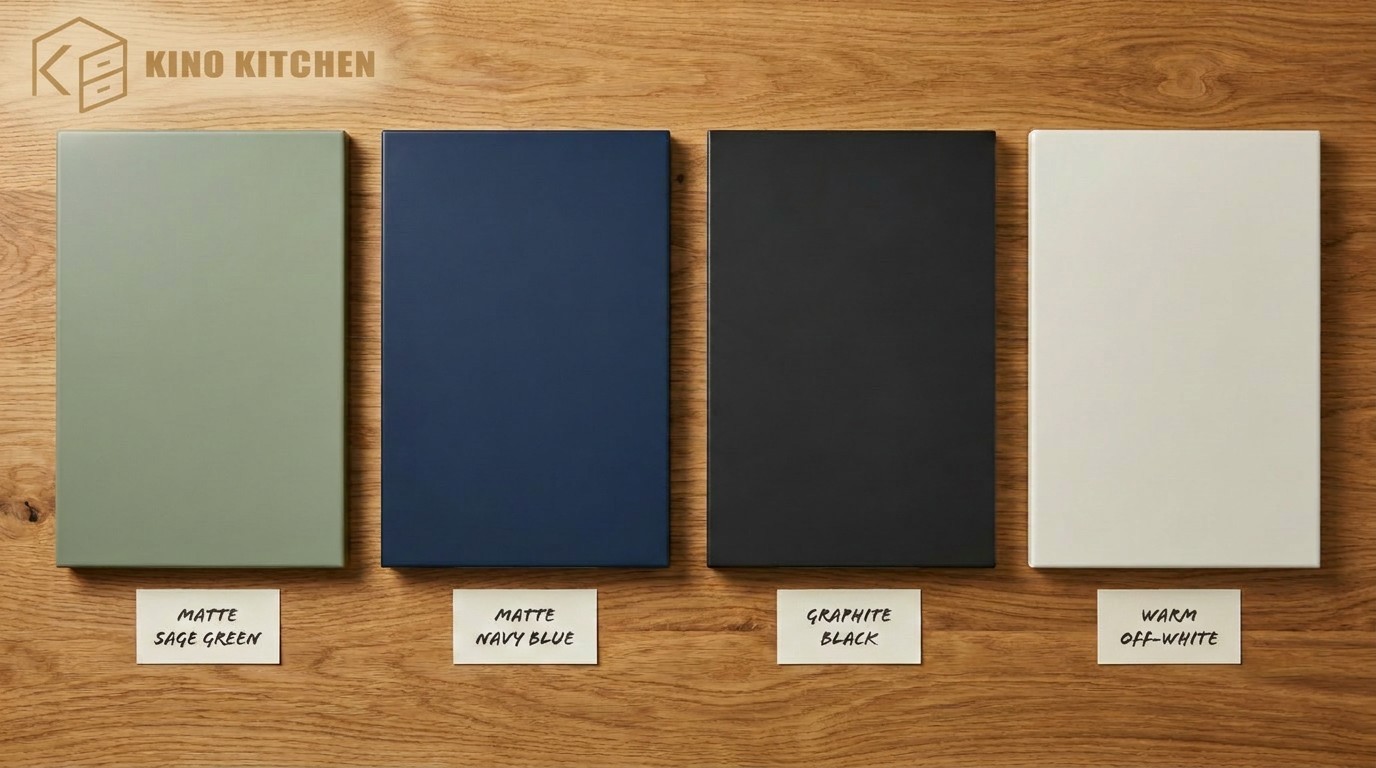
Dry polymer resins are heat-cured onto the steel surface, creating a finish that covers over 75 standard colors — including the matte greens, warm whites, deep blacks, and champagne tones that dominate current design trends. Powder coating is UV-stable, chemical-resistant, and handles outdoor conditions better than any other finish option. It's worth knowing that over 85% of outdoor kitchen cabinets now ship with powder-coated finishes for exactly this reason.
For homeowners who want the structural benefits of stainless steel but prefer a colored kitchen aesthetic — sage green, slate gray, off-white — powder coating closes that gap entirely.
PVD-Coated (Physical Vapor Deposition)
PVD coating is a vacuum-applied thin-film process that bonds metallic color directly to the steel surface at a molecular level. The result is a finish that looks genuinely metallic — not painted — in colors like champagne gold, rose gold, gunmetal, and brushed bronze that are impossible to achieve with standard finishing methods.
PVD coatings are substantially harder than the underlying steel (typically 3–5x harder on the Vickers scale), which means they resist scratching, chipping, and corrosion better than conventional coatings. In 2025 and into 2026, PVD finishes in warm metallic tones — champagne gold, bronze, and warm silvers — are among the fastest-growing specifications in high-end residential kitchen design, driven by a broader interior design shift toward warmer, more textural palettes.
The trade-off is cost: PVD finishing adds meaningfully to fabrication price and is not available from all suppliers. For a kitchen designed to hold its design value for a decade, it's often worth the premium.
Anti-Fingerprint Nanocoating
Hydrophobic and oleophobic surface treatments — sometimes marketed as "fingerprint-resistant" or "nano-coating" — repel skin oils and water without altering the visible appearance of the steel. The brushed metallic look is preserved while cleaning frequency drops noticeably. Particularly practical in households with children or high kitchen traffic.
How to Submit Measurements Correctly
Measurement errors are the single most common reason custom cabinet orders come back wrong. And unlike an off-the-shelf return, a mis-fabricated custom cabinet means weeks of rework and, sometimes, starting over.
What You Need to Document
Before contacting a fabricator, prepare the following:
Overall room dimensions: floor-to-ceiling height, wall-to-wall widths for each run of cabinetry
Soffits and bulkheads: any ceiling drops, ductwork, or structural features that reduce usable height
Appliance cutouts: exact model dimensions for refrigerators, ovens, dishwashers, and any built-in appliances
Plumbing and electrical clearances: sink rough-in locations, electrical box positions, gas line locations
Irregular features: alcoves, angled walls, columns, or architectural elements that affect cabinet placement
Floor plan or CAD drawing: even a hand-drawn sketch with dimensions speeds the quoting process significantly; most fabricators can produce 3D shop drawings from basic plans
Measurement Best Practices
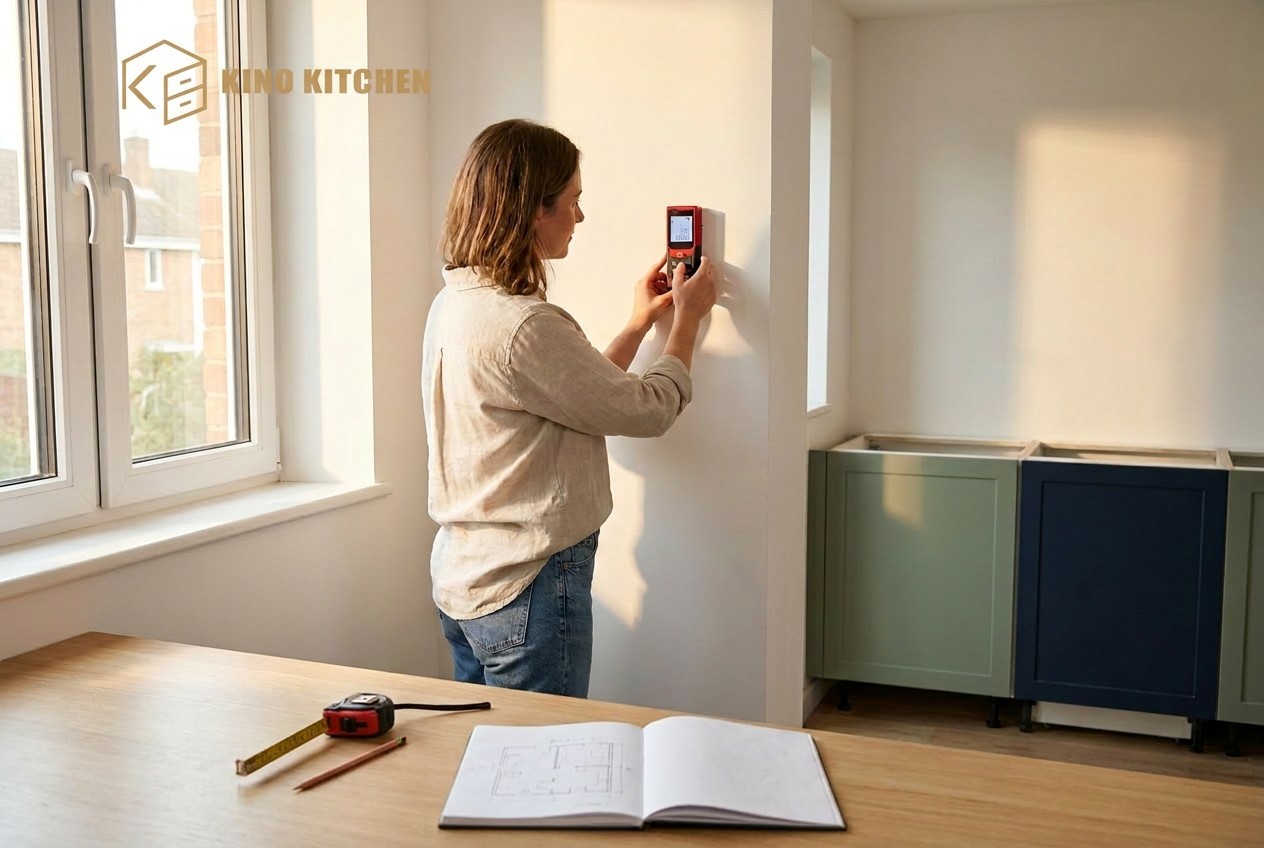
Measure each wall run at least three times — top, middle, and bottom — because walls are rarely perfectly square. Record the smallest dimension. In older homes, floors are rarely level; confirm the lowest point in the room before finalizing base cabinet heights.
If you're working with an interior designer or contractor, confirm who takes ownership of final measurements before fabrication begins. This question matters because measurement errors discovered post-fabrication are almost always the buyer's responsibility, not the fabricator's.
Lead Times: What's Realistic in 2025?
Custom stainless steel cabinets are not stocked items. Production begins after you approve the final shop drawings — which means the clock starts later than most buyers expect.
| Cabinet Type | Typical Lead Time |
|---|---|
| Modular / standard units | 1–3 weeks |
| Semi-custom fabrication | 3–5 weeks |
| Fully custom fabrication | 5–10 weeks |
| Complex bespoke projects (PVD, specialized hardware) | 10–16 weeks |
Several variables compress or extend these timelines:
Design approval: Most fabricators won't begin cutting steel until you've signed off on detailed shop drawings. If the review-and-revision cycle takes two weeks, those two weeks don't run concurrently with production — they happen before it.
Finishing processes: PVD coating and powder coating require dedicated curing or chamber time that adds days to the production schedule. If your chosen finish is outsourced to a specialty finisher, add their queue time to the estimate.
Fabrication complexity: Cabinets with seamless welded corners, integrated pulls, or unusual geometry require more skilled labor hours than standard box-and-door assemblies. Complex projects scheduled during a busy shop period can slip.
Current shop capacity: Lead times fluctuate with order volume. The number a fabricator quotes in January may look different in May. Get lead time commitments in writing, tied to a specific production start date.
If your cabinets are part of a broader kitchen renovation with scheduled plumbers, electricians, and countertop installers, build at least two weeks of buffer into your timeline. One delay in a coordinated remodel tends to cascade.
Understanding the True Cost
Stainless steel cabinetry costs more than wood or MDF — typically two to three times more per linear foot. That's not a reason to avoid it; it's a reason to understand exactly what you're paying for.
Current Market Pricing (2025)
Per linear foot (installed): $500–$1,200
Complete kitchen: $25,000–$38,000+
Wide ranges like these are real, not vague. The spread between $500 and $1,200 per linear foot reflects genuine differences in steel grade, gauge, finish complexity, hardware quality, fabrication craftsmanship, and geographic labor costs.
What Drives the Cost
Steel grade: Upgrading from 304 to 316 typically adds 10–30% to material costs. In coastal or high-humidity environments, that premium is a sound investment.
Gauge thickness: Moving from 18-gauge to 16-gauge can increase steel costs by up to 40% for the same footprint. For most residential kitchens, 18-gauge performs identically to 16-gauge in practice.
Finish type: Standard brushed finish is the baseline. Powder coating adds a secondary processing cost. PVD coating adds a significant premium but delivers a finish quality unavailable through other methods.
Hardware: Soft-close hinges, heavy-duty undermount drawer slides, and solid metal pulls are meaningfully more expensive than standard hardware — and meaningfully better in daily use.
Installation: This is the most commonly missed line item. Some fabricators quote cabinetry only; installation is quoted separately by a contractor. Others offer installed pricing. Confirm which you're looking at before comparing quotes.
How to Read a Quote
Request itemized quotes that break out:
Material (steel grade, gauge, quantity)
Fabrication labor
Surface finishing
Hardware
Delivery / freight
Installation (if included)
Any applicable lead time deposits or change-order policies
A line-by-line quote lets you identify where you can make value decisions. An all-in number makes it nearly impossible to compare suppliers or understand what you'd be cutting if you need to reduce cost.
10 Questions to Ask Before You Sign
These are the questions that separate good fabrication partnerships from expensive misunderstandings:
What steel grade do you use, and can you provide mill certification documentation?
What gauge thickness are you specifying for cabinet bodies versus door panels?
How do you handle measurement discrepancies discovered after fabrication begins?
What is your revision policy on shop drawings before production starts?
Who performs the finishing — in-house or outsourced? How does that affect lead time?
What is your tolerance for dimensional variation, and how are deviations handled?
Is installation included in this quote, or is it a separate cost?
What warranty do you provide on fabrication and finish?
What does your change-order process look like after production has started?
Can you provide references or portfolio photos from comparable residential projects?
The answers to these questions tell you as much about the fabricator's professionalism as they do about the cabinets themselves.
Frequently Asked Questions
How long do stainless steel kitchen cabinets last? With appropriate care, 304 or 316 stainless steel kitchen cabinets routinely last 30–50 years — well beyond the lifespan of wood, laminate, or MDF alternatives. The material doesn't warp, swell, or delaminate. Surface finish may require touch-up over time, particularly on powder-coated or PVD-finished units, but the structural integrity of the steel itself doesn't degrade under normal residential use.
Can stainless steel cabinets be used in any kitchen style? Yes. Modern finish options — powder coating in 75+ colors, PVD metallic tones, brushed satin, matte nanocoating — allow stainless steel to function in design contexts ranging from strict industrial minimalism to warm farmhouse aesthetics. The material is no longer confined to the professional or sterile-kitchen look. A sage green PVD cabinet paired with warm wood open shelving reads nothing like a restaurant kitchen.
Will stainless steel cabinets show dents easily? 18-gauge and 16-gauge stainless steel is substantially more dent-resistant than wood-veneer or MDF cabinets with standard door skins. Stainless steel will dent under direct sharp impact, but everyday contact — doors closing, items stored inside, normal kitchen activity — doesn't produce visible damage on properly gauged steel.
What's the best way to maintain stainless steel kitchen cabinets? Daily: wipe with a soft cloth, always in the direction of the grain for brushed finishes. Weekly: clean with mild dish soap and warm water. Avoid abrasive pads, chlorine bleach, and any cleaner containing ammonia. Address any surface scratches on brushed finishes with a dedicated stainless steel polish applied in the grain direction. Powder-coated and PVD surfaces require even less maintenance — typically just wiping with a damp cloth.
Are custom stainless steel cabinets worth the cost? For most buyers who ask this question, the honest answer is: compared to what? Against premium wood cabinetry, custom stainless steel is comparably priced and substantially more durable. Against mid-range wood or MDF, it costs more upfront and significantly less over a 20-year ownership horizon when you account for replacement, repainting, and moisture damage. If the kitchen you're designing is meant to last, the math generally favors stainless steel.
Ready to Move Forward?
Ordering custom stainless steel kitchen cabinets is not complicated — but it does require preparation. The homeowners who end up unhappy are almost always the ones who made grade, gauge, or measurement decisions under time pressure without understanding the implications.
Take the time to confirm your steel grade in writing. Specify your gauge for both cabinet bodies and door panels. Understand what your chosen finish requires in terms of maintenance and lead time. Request an itemized quote. Ask the ten questions above before you sign.
Do those things, and the cabinets that arrive will be the ones you actually ordered.

Get a Free Design Consultation Today — Contact our team to discuss your project specifications, request material samples, and receive a detailed, itemized quote with no obligation.

.png)
.png)
.png)


